Optics Brand · Trijicon
Trijicon: brand guide, lineup and warranty
Researched by James · Updated September 26, 2026 · Editorial policy
On this page
Founding date and headquarters come from Trijicon's own site. Warranty terms, current lineup and prices are pulled directly from Trijicon's product and warranty pages, checked September 2026; prices change and vary by retailer. Full methodology & editorial policy →
Quick facts
| Founded | 1981 |
|---|---|
| Headquarters | Wixom, Michigan (additional facility in Auburn, California) |
| Where made | Not published as a single blanket claim across the catalog; verify country of origin for a specific model directly with Trijicon or a dealer before buying if it matters to you |
| Parent company / owner | Privately held; no publicly disclosed outside parent company |
| Known for | The ACOG and battery-free tritium/fiber-optic illumination; also RMR and SRO red dots and REAP-IR thermal |
| Typical price range | About $685 (Ascent/Huron entry models) to $9,784 (REAP-IR 60mm thermal); ACOG runs $1,524-$2,438 |
| Warranty | Lifetime on material/workmanship for the original owner; tritium 10-15 years; electronics on Credo/MRO/RMR Type 2/SRO 5 years; IR thermal optics lifetime, electronics 3 years |
What does Trijicon make?
Trijicon's catalog splits cleanly into two philosophies: battery-free "any-light" optics (ACOG, AccuPoint, tritium night sights) that rely on tritium and fiber optics rather than electronics, and conventional battery-powered hunting and tactical scopes (Ascent, Huron, Credo, Tenmile) that compete directly with Leupold and Vortex on features and price. It also builds red dots (RMR, SRO, MRO) and a premium thermal line (REAP-IR, IR-HUNTER) for hunters and shooters who need heat-detection capability.
Current lineup
| Line | Type | Magnification | Typical price | Best for |
|---|---|---|---|---|
| Ascent | Hunting riflescope | 1-4x24 to 4-16x50 | $685-$985 | Budget hunters wanting Trijicon glass |
| Huron | Hunting riflescope | 1-4x24 to 4-16x50 | $685-$985 | Straightforward, versatile deer and hog hunting |
| Credo / Credo HX | Hunting & tactical hybrid | 1-4x24 to 2.5-15x56 | $890-$2,258 | Hunters who also want an AR-compatible low-power option |
| AccuPoint | Battery-free illuminated hunting scope | 3-18x50 (current model) | About $1,996 | Hunters who want an always-on dot with zero battery dependence |
| ACOG | Fixed-power tactical/hunting | 3.5x35, 4x32 | $1,524-$2,438 | Battery-free close-to-medium range aiming |
| Tenmile | Precision hunting/tactical | 3-18x44 | About $2,462 | Long-range hunters wanting first focal plane precision |
| VCOG | Flagship variable prism optic | 1-8x28 | About $3,528 | Military/duty-grade AR optic, overkill for most hunting |
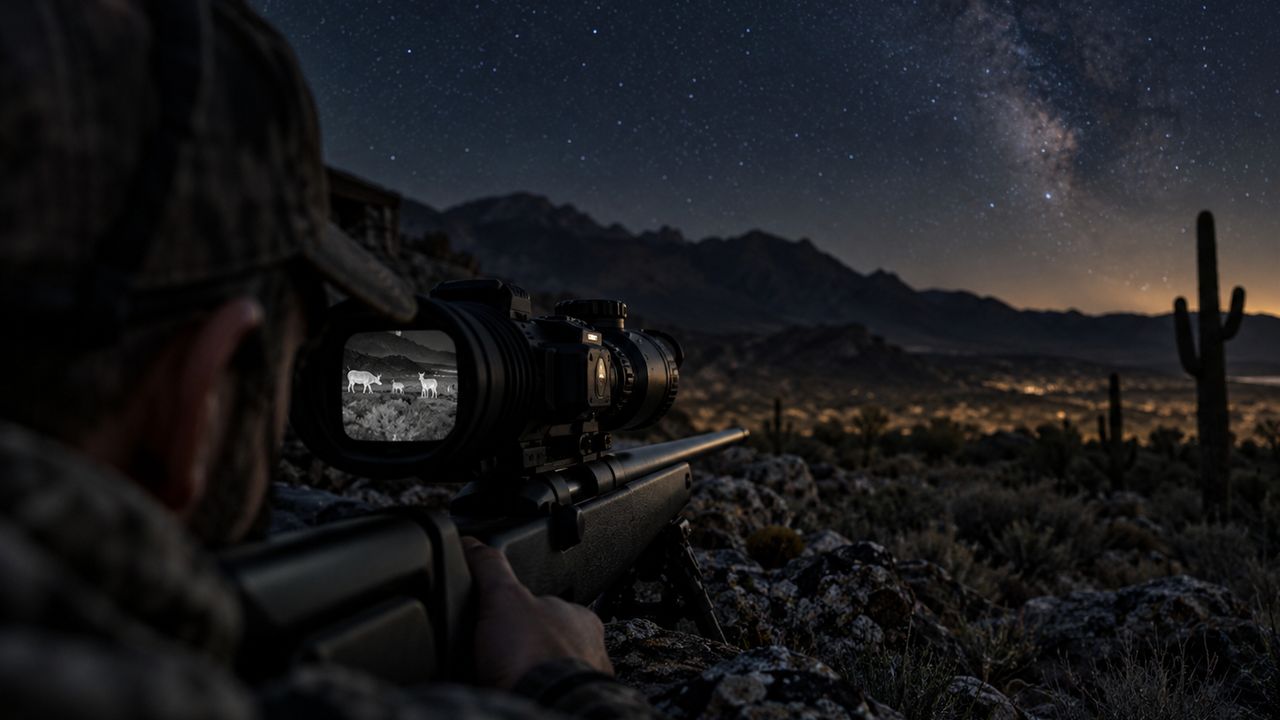
| REAP-IR | Thermal riflescope | 24mm to 60mm lens | $7,209-$9,784 | Premium thermal for hunters who need heat detection |
Trijicon has been steadily expanding its variable-power riflescope lines in recent years, so check current listings for configurations and reticles beyond what's shown here; prices above are Trijicon's own site as of September 2026.
Best Trijicon picks for hunting
- Huron — the default recommendation for a straightforward hunting scope at Trijicon's most accessible price point.
- Credo — worth the step up for hunters who also want a low-power variable that works on an AR platform.
- AccuPoint — the pick if you specifically want an illuminated reticle that can't run out of battery mid-hunt.
Mount and level whichever Trijicon scope you choose before zeroing — see how to mount and level a scope and how to sight in a rifle scope. If you're deciding between a first and second focal plane reticle on the Credo or Tenmile lines, FFP vs SFP scopes explains which one actually matters for your kind of hunting.
Pros and cons
Good fit
- Hunters who want an illuminated reticle with zero battery dependence (AccuPoint, ACOG)
- Shooters who want one brand covering hunting scopes, red dots and thermal
- Buyers comfortable paying a premium for a long-established US-headquartered optics maker
Look elsewhere
- Budget-first buyers — Trijicon's entry price sits above brands like Primary Arms or Athlon
- Anyone wanting a single, verifiable country-of-origin claim across the whole catalog
- Airgun hunters shooting close range on high power — most Trijicon hunting scopes fix parallax at 100 yards
How Trijicon compares
Against Leupold, Trijicon's battery-free illumination technology (tritium and fiber optics) is a genuine point of difference that Leupold's conventional battery-powered illuminated reticles don't match, though Leupold assembles its whole line at one Oregon facility for a simpler manufacturing story. Against Vortex, Trijicon sits at a higher price floor without Vortex's unconditional VIP-style warranty breadth, but wins on battery-free reliability in the field. Against Sig Sauer, Trijicon's ACOG and AccuPoint occupy a niche Sig doesn't really compete in, while Sig's BDX rangefinder-to-scope system is a convenience feature Trijicon doesn't offer.
Verdict
Trijicon is the right call for a hunter or shooter who wants an illuminated reticle that can't fail from a dead battery, and is willing to pay for it. If budget is the priority, or you want the deepest possible price ladder from entry to premium under one warranty, Vortex or Primary Arms cover more ground for less money.
Shop Trijicon
As an Amazon Associate, James Southern Outdoors earns from qualifying purchases. Some links may earn a commission at no cost to you. Prices and availability change. Retailer never decides the recommendation.
If you'd rather film your hunts through the scope than run a traditional optic, my scope-cam setup guide covers the gear and mounting order that works, and my Arken Outrider review (Arken sponsors my channel) covers a very different, much cheaper optic at the opposite end of the price spectrum from Trijicon's flagship lines.
FAQ
Is Trijicon a good brand?
Yes, particularly if you want an illuminated reticle that doesn't depend on a battery. Trijicon built its reputation on tritium and fiber-optic illumination in the ACOG and AccuPoint lines, technology that keeps working with zero electronics to fail in the field. Its hunting-focused Huron and Ascent scopes are more conventional battery-powered designs priced to compete directly with Leupold and Vortex.
Where is Trijicon located, and where are its products made?
Trijicon is headquartered at 49385 Shafer Avenue in Wixom, Michigan, with an additional facility in Auburn, California. The company doesn't publish a single blanket manufacturing statement covering every product line the way it does its Michigan address, so treat country-of-origin claims for a specific model as something to verify directly with Trijicon or a dealer before buying if that matters to you.
Who owns Trijicon?
Trijicon is a privately held company founded in 1981; it doesn't publicly disclose a parent company or outside ownership stake beyond that. That's typical for a company of its size and age in the optics industry, and it means less public financial detail is available compared with a publicly traded competitor.
What's the best Trijicon scope for hunting?
The Huron (about $685-$985) is the value pick for a straightforward hunting scope with Trijicon's optical quality. Step up to the Credo (about $890-$2,258) if you want a more versatile hunting-and-tactical hybrid with more reticle and focal-plane options, or the AccuPoint if a battery-free, always-on illuminated dot matters more to you than raw feature count.
What makes the ACOG different from a normal scope?
The ACOG (Advanced Combat Optical Gunsight) uses a tritium phosphor lamp and a fiber-optic light pipe to illuminate its reticle with no battery at all, so it's always on and never runs out of charge in the field. It's fixed-power rather than variable, which is standard for the design, and Trijicon's official pricing runs from about $1,524 to $2,438 depending on magnification and reticle.
What's Trijicon's warranty?
Trijicon warrants products against defects in material and workmanship for the lifetime of the original owner, with different timed coverage layered on top: tritium illumination is guaranteed for 10-15 years depending on the product, night sight tritium for 12 years, and electronic components on models like Credo, MRO, RMR Type 2 and SRO for 5 years from the manufacture date. IR thermal scopes get lifetime coverage on the optical housing and 3 years on electronics.
Does Trijicon make thermal scopes?
Yes — the REAP-IR line runs $7,209 (24mm lens) to $9,784 (60mm lens), all built around a 640x480 thermal sensor, and the IR-HUNTER is a related clip-on/standalone thermal option. That's a genuinely premium price tier; for a wider spread of thermal options by budget, including sub-$2,000 entry points, see my best thermal scopes for hunting guide.
Is a Trijicon scope a good fit on an air rifle?
Mechanically yes, but check parallax and recoil rating first. Most Trijicon hunting scopes are built and parallax-set for firearm distances (100 yards), so close-range airgun pest control at 20-40 yards can show real parallax error on higher magnification; see best air rifle scopes for what actually matters on an airgun-specific optic.