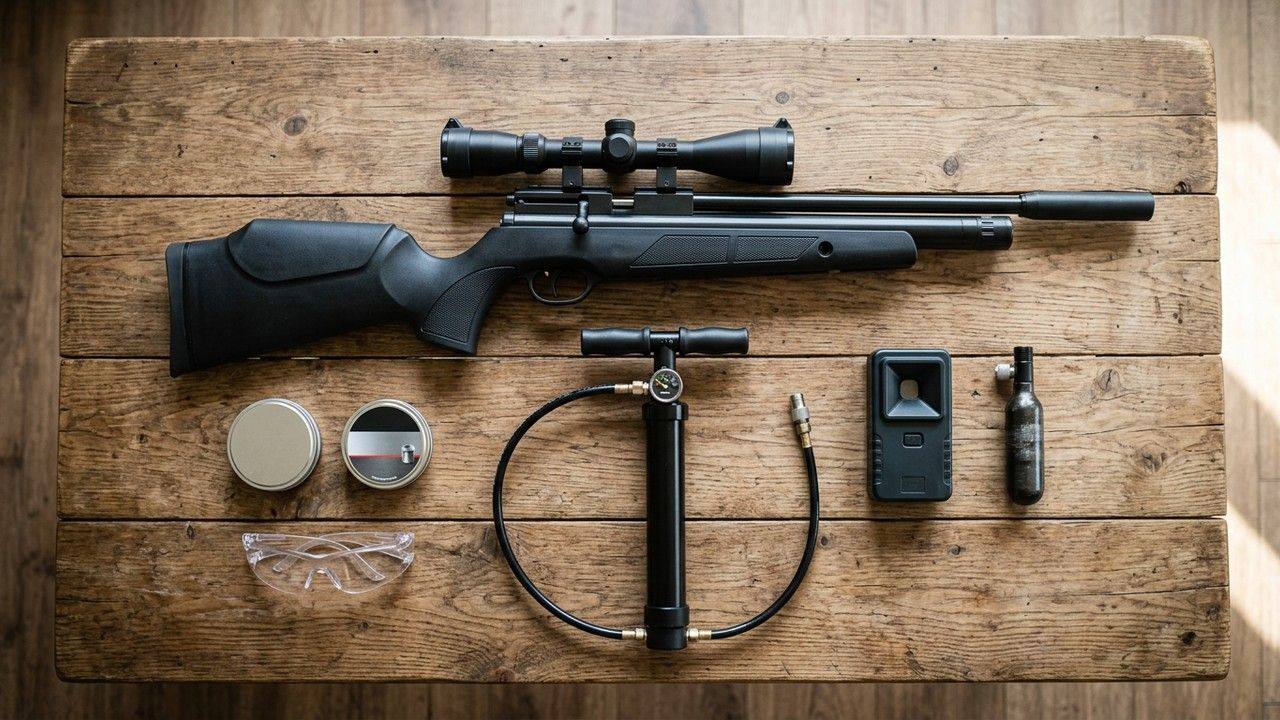
Buyer's Guide · PCP Air
How to fill a PCP: hand pump vs tank vs compressor
By James · Published · Updated · Editorial policy
On this page
Prices, fill times, and tank ratings come from manufacturer and retailer spec pages and Outdoor Life's compressor tests, linked in Sources and current as of this update. The recommendations are my opinion as a PCP hunter. Full methodology & editorial policy →
The three ways to fill a PCP, compared
| Method | Upfront cost | Effort / time | Best for | Watch out for |
|---|---|---|---|---|
| Hand pump | Under ~$250 | ~120 strokes for a small rifle like the Umarex Origin; 200+ on larger reservoirs | 3,000–3,625 psi rifles, low shot volume, no shop nearby | Gets hard above ~2,500–3,000 psi; heat and moisture; tiring for big bottles |
| Scuba tank (3,000 psi class) | ~$275–300 new, ~$100 used | Minutes per fill, plus refill trips | 3,000 psi rifles, dive shop nearby | Can't fully fill a rifle once tank pressure drops near rifle pressure; inspection rules at fill shops |
| Carbon fiber tank (4,500 psi) | ~$570 (Air Venturi Wingman 74 cu ft) | Minutes per fill, plus refill trips | Most hunters with a shop within reach | Needs a 4,500 psi-capable fill source; tanks carry service-life and re-test requirements |
| Portable compressor | ~$419–$799 (Outdoor Life-tested units) | Nomad III: 0→3,000 psi in a 250cc reservoir in ~9 min | High volume, 4,500 psi rifles, slug shooters, remote areas | Heat, moisture filtration, maintenance; cheap units skip filtration |
Option 1: the hand pump
It's the entry ticket to PCP shooting and the only option that works anywhere. Umarex says its Origin takes about 120 pumps per fill, and larger reservoirs can need 200-plus. Tom Gaylord's 2026 write-up on Pyramyd AIR's blog describes the effort curve most shooters feel: easy to about 2,000 psi, hard at 2,500, very hard at 3,000.
- Do: pump in short sessions to manage heat, keep the pump's moisture filter serviced, and bleed the pump as the manual says.
- Don't: expect to live on a hand pump with a 4,500 psi rifle. Pyramyd AIR recommends a compressor for 4,500 psi guns.
Option 2: the tank (scuba or carbon fiber)
A tank is a big bottle of air you get filled at a dive or paintball shop, then decant into your rifle. The limitation is physics. Air only flows from higher to lower pressure, so a 3,000 psi scuba tank can top a 3,000 psi rifle all the way only a few times before it can't anymore. A 4,500 psi carbon fiber tank fixes that. Air Venturi rates its 74 cu ft Wingman at more than 15 full charges of an empty 3,000 psi, 215cc rifle, or about 32 top-offs from 1,500 psi.
Before you buy, call your local shops. Confirm they'll fill airgun tanks to 4,500 psi and ask about their inspection requirements.
Option 3: the portable compressor
A compressor turns electricity into air at home or from a truck battery. In Outdoor Life's compressor tests, the portable 4,500 psi units ranged from about $419 (Hatsan TactAir Spark) to $799 (Air Venturi Nomad III), and the Nomad III filled a 250cc reservoir from 0 to 3,000 psi in about 9 minutes. Pyramyd AIR's buying guide flags what separates good units from cheap ones: moisture and oil filtration, cooling with thermal shutoff, and an adjustable auto-stop pressure.
- Do: run it with its filter serviced and let it cool between long runs.
- Don't: buy a unit with no moisture filtration. Water in a PCP reservoir causes internal corrosion.
Which one should you buy?
My recommendation by situation
- First PCP, 3,000 psi fill, casual shooting: hand pump. Spend the difference on pellets and a chronograph.
- Serious rabbit or pest hunter with a shop within reach: carbon fiber tank. Fastest fills per dollar.
- 4,500 psi rifle, high-power slugs, or no shop nearby: portable compressor with real filtration.
- FX Impact M4 (250 bar / 3,625 psi): a hand pump works in a pinch. At hunting power a tank or compressor is the realistic long-term answer. Full context in my Impact M4 review.
How do you fill a PCP safely, step by step?
Fill a PCP safely by wearing eye protection, confirming your rifle's maximum fill pressure, checking the fill fitting and its seals, filling slowly while you watch the gauge, stopping at the rated pressure, bleeding the line before you disconnect, and storing the rifle properly. The steps below follow the owner's manuals from Crosman (Benjamin Marauder and its charging system), Umarex (Gauntlet) and FX (Impact M4), linked in Sources. Your own manual overrides this page.
- Put on eye protection. Benjamin's charging-system manual says "ALWAYS WEAR EYE PROTECTION WHEN WORKING WITH COMPRESSED GAS." Crosman's Marauder manual says you and others with you should always wear shooting glasses, Umarex's Gauntlet manual says the same, and FX recommends eye protection.
- Confirm your rifle's maximum fill pressure. Check the manual and the markings on the air reservoir, because the pump's or tank's rating never raises the rifle's limit. Crosman's Marauder manual says "DO NOT fill the airgun to more than 3000 psi," Umarex's manual for the original Gauntlet gives 3,000 psi (207 bar), and FX lists 250 bar for a single-regulator Impact M4 (300 bar for dual). Many PCPs fall in the 3,000 to 4,500 psi (200 to 300 bar) range, so check your rifle's rating instead of assuming.
- Check the fill probe or adaptor and its O-rings. Crosman's Marauder manuals and Umarex's Gauntlet manual specify a hand pump fitted with a Foster #12FS quick disconnect, and Crosman says to keep the fill nipple capped so dirt stays out of the check valve. Benjamin's charging manual says to make sure the valve O-ring sits at the top of the threaded portion, and FX ships its connector with a seal attached. Pyramyd AIR's Tom Gaylord says the double O-rings on a quick-disconnect probe need frequent cleaning, and he describes one leaking rifle whose seals "were just dirty."
- Close the bleed valve, then connect. FX's fill sequence is to close the ventilation screw on the charging source, then push the quick connector onto the rifle's male fitting. Use dry air only, since FX warns never to use oxygen or any other gas.
- Fill slowly while watching the gauge. Benjamin's charging manual says to open the valve slowly and let air enter the rifle slowly. Umarex warns that filling too fast builds heat and gives an inaccurate reading, and FX notes the gauges on the gun are indicators and not 100% accurate, so read the fill gauge and don't guess.
- Stop at the rated pressure, then bleed the line and disconnect. Benjamin's manual says to stop when the gauge reaches the gun maker's recommended working pressure, and Umarex says "DO NOT OVERFILL." Before you pull the hose, open the bleed screw: Crosman says to bleed it completely to avoid hose whip, and Benjamin's charging manual says the gauge will read zero "and only then is it safe to disconnect the hose." Put the dust cap back on.
- Store the rifle and air safely. Crosman's Marauder manuals say to store the airgun charged with air to keep the valves closed against dirt, and the BP1764-series manual adds unloaded and away from children. FX says to store it dry and dark, never with a loaded magazine, and to keep it out of sunlight that can damage O-rings. Umarex says never to expose filled cylinders to temperatures above 122°F (50°C), so don't leave a filled rifle or tank in a hot vehicle.
Air-support gear
As an Amazon Associate, James Southern Outdoors earns from qualifying purchases. Some links may earn a commission at no cost to you. Prices and availability change. Retailer never decides the recommendation.
Next step: the first-PCP buyer's guide puts the air system into a full day-one budget.
FAQ
What is the cheapest way to fill a PCP air rifle?
A high-pressure hand pump, usually under $250. It works best on rifles that fill to 3,000–3,625 psi with small air tanks. The trade is effort: a full fill can take 100–200+ strokes, and pumping gets hard above about 2,500–3,000 psi.
Can you fill a PCP with a hand pump?
Yes, for most rifles that fill to 3,000–3,625 psi. It gets impractical for 4,500 psi rifles and large bottles, which Pyramyd AIR recommends filling from a compressor.
Is a compressor worth it for a PCP?
If you shoot more than a few hundred shots a month, have a 4,500 psi rifle, or run a high-power slug setup, yes. Portable 4,500 psi compressors tested by Outdoor Life run about $419–$799, and the Air Venturi Nomad III filled a 250cc reservoir from 0 to 3,000 psi in about 9 minutes.
Can you fill a PCP from a scuba tank?
Yes, with a fill adapter, up to the tank's pressure. A standard 3,000 psi scuba tank loses the ability to fully fill a 3,000+ psi rifle as its own pressure drops, so you get fewer full fills than you'd expect. Carbon fiber tanks rated to 4,500 psi solve that.
How many fills do you get from a carbon fiber tank?
It depends on tank size and rifle reservoir. Air Venturi rates its 74 cu ft, 4,500 psi Wingman tank at more than 15 full charges of an empty 3,000 psi rifle with a 215cc reservoir, or about 32 top-offs from 1,500 psi.
What fill pressure does the FX Impact M4 use?
The FX Impact M4 fills to 250 bar (3,625 psi) maximum. That's hand-pumpable, but the M4's air use at hunting power makes a tank or compressor far more practical.
How do you fill a PCP air rifle safely?
Wear eye protection, confirm your rifle's maximum fill pressure in its manual, check the fill fitting and its seal, and close the bleed valve before you connect. Fill slowly while watching the gauge, stop at the rated pressure, then bleed the line before you disconnect. Crosman's Marauder manual caps fills at 3,000 psi, and FX lists 250 bar for a single-regulator Impact M4.
What happens if you don't bleed the fill hose before disconnecting a PCP?
The hose can whip when it comes off. Crosman's Marauder manual says to bleed the fill hose completely to avoid hose whip, and Umarex's Gauntlet manual gives the same warning. Benjamin's charging-system manual says to open the bleed screw until the gauge reads zero and only then disconnect.
How do I find the maximum fill pressure for my PCP?
Read your rifle's manual and the markings on its air reservoir, not the rating of your pump or tank. Crosman's Marauder manual and Umarex's manual for the original Gauntlet both give 3,000 psi (the Gauntlet 2 is rated to 4,500 psi), while FX lists 250 bar for a single-regulator Impact M4 and 300 bar for dual. Many PCPs fall between 3,000 and 4,500 psi (200 to 300 bar), so check your rifle's rating.
Sources
- Umarex USA — How to fill a PCP air rifle: hand pumps, compressors, tanks, and NitroAir
- Umarex USA — PCP tank size and filling recommendations
- Pyramyd AIR — Guide to buying a PCP compressor
- Pyramyd AIR blog — Filling options for precharged pneumatic airguns, Part One (Tom Gaylord, May 2026)
- Pyramyd AIR — Air Venturi Wingman 74 cu ft carbon fiber tank (specs)
- Outdoor Life — Best PCP air rifle compressors, tested (Jim Chapman)
- Airgun Depot — FX Impact M4 specifications
- Crosman — Benjamin Marauder owner's manual (BP1763 / BP2263 / BP2563)
- Crosman — Benjamin Marauder owner's manual (BP1764 / BP2264 / BP2564)
- Crosman — Benjamin PCP Air Gun Charging System owner's manual (Model 81001)
- Umarex USA — Gauntlet owner's manual (item nos. 2252603 / 2252604)
- FX Airguns — Impact M4 owner's manual
- Pyramyd AIR blog — How to maintain a PCP airgun (Tom Gaylord)