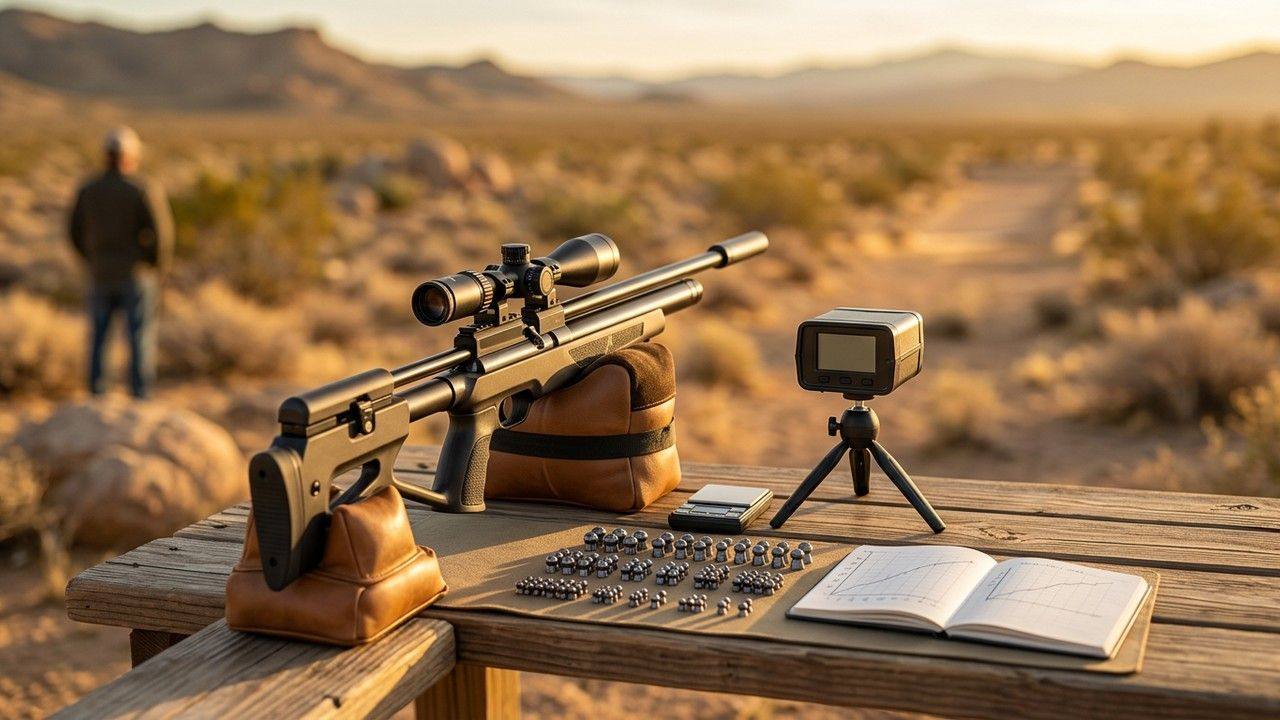
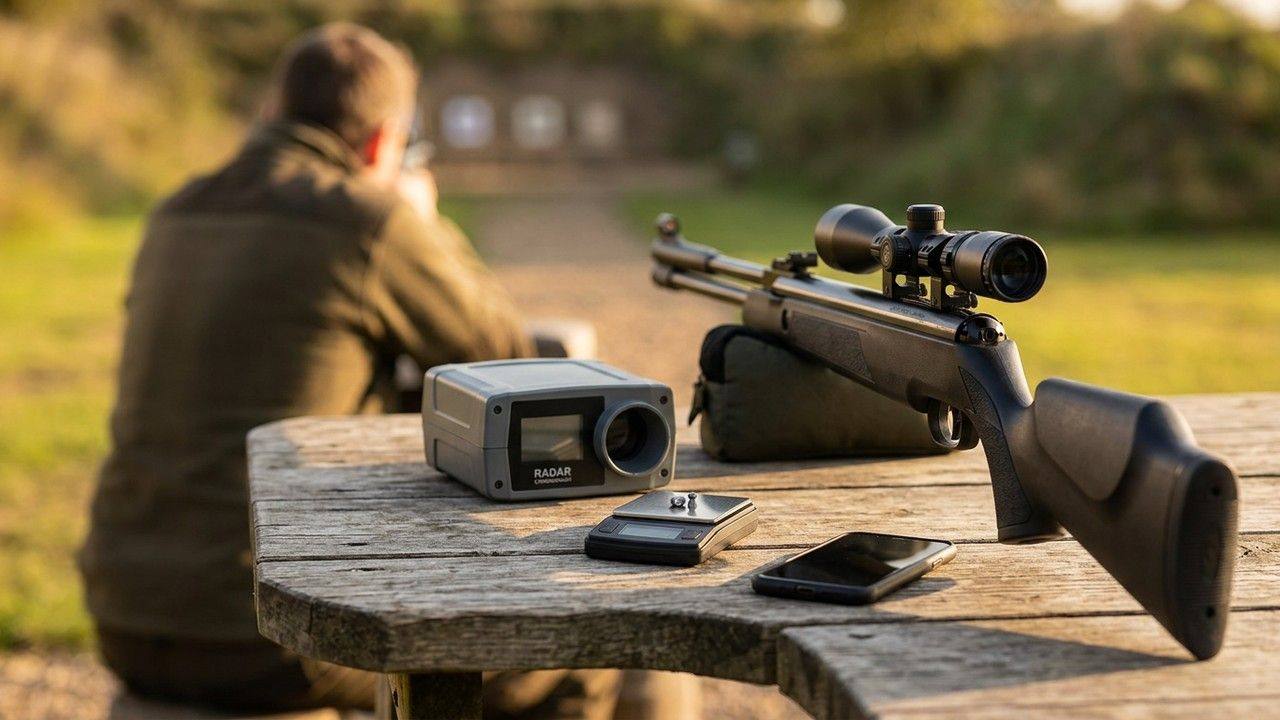
Energy Guide · FPE
Air Rifle FPE for Hunting: The Complete Guide
Researched by James · Updated · Editorial policy
On this page
- How much FPE do you need to hunt with an air rifle?
- What is FPE, and how do you calculate it?
- How much energy does a pellet or slug keep at 25, 50 and 75 yards?
- How much FPE do you need at the target for each quarry?
- Which states set caliber or energy minimums for airgun hunting?
- What are the UK 12 ft-lb and Germany 7.5 J limits?
- How do you measure your own air rifle's FPE with a chronograph?
- How do you raise or lower an air rifle's FPE safely?
- Is more FPE always better for hunting?
- FAQ
- Sources
The formula and quarry floors match the site's airgun FPE chart and FPE calculator. The retained-energy numbers are computed estimates from Hard Air Magazine's measured ballistic coefficients, not field measurements. State and country rules were read on the agency or legal-text pages linked below; rules change, so confirm before you hunt. Full methodology & editorial policy →
How much FPE do you need to hunt with an air rifle?
Plan on 9-12 FPE at the animal for rabbits and squirrels, about 6 FPE for rats and sparrows, and about 25 FPE for raccoon-size animals, always with a head shot. Because a pellet sheds energy on the way, those are targets for the target, not the muzzle. The quarry-by-quarry version is on the airgun FPE chart; this guide shows where the numbers come from and how to check your own rifle.
FPE comes from weight and speed, which is why FPS alone misleads, and placement decides whether any of it works: see airgun shot placement.
What is FPE, and how do you calculate it?
FPE is foot-pounds of energy, the kinetic energy of a pellet or slug in the unit airgunners use: FPE = weight in grains × velocity in fps² ÷ 450,436. The divisor is 2 × 32.174 ft/s² (standard gravity) × 7,000 grains per pound, and it is the one used across this site. Some sources print 450,240 (Pyramyd AIR and Air Arms do). The two differ by about 0.04%, so 18.13 grains at 900 fps is 32.6 FPE either way. Multiply by 1.3558 for joules.
| Load | Weight | Speed | Muzzle energy | Joules |
|---|---|---|---|---|
| .177 pellet | 8.44 gr | 900 fps | 15.2 FPE | 20.6 J |
| .22 pellet | 18.13 gr | 900 fps | 32.6 FPE | 44.2 J |
| .25 pellet | 33.95 gr | 900 fps | 61.1 FPE | 82.8 J |
| James's .22 slug load (ACE FRAG) | 40.1 gr | about 950 fps | 80.3 FPE | 108.9 J |
Computed: FPE = grains × fps² ÷ 450,436. Run your own load in the FPE calculator, which also works backwards to the speed a target energy needs.
How much energy does a pellet or slug keep at 25, 50 and 75 yards?
A .22 pellet keeps about 80% of its muzzle energy at 25 yards, 66% at 50 and 55% at 75, while a slug launched with similar muzzle energy keeps about 92%, 84% and 77%. All figures below are computed estimates, not chronograph readings.
| Load | Weight | Muzzle speed | BC | Muzzle energy | At 25 yd | At 50 yd | At 75 yd |
|---|---|---|---|---|---|---|---|
| .22 JSB Exact Jumbo Heavy pellet | 18.13 gr | 930 fps | 0.035 | 34.8 FPE | 27.9 FPE (80%) | 22.9 FPE (66%) | 19.0 FPE (55%) |
| .25 JSB Exact King Heavy MkII pellet | 33.95 gr | 860 fps | 0.046 | 55.7 FPE | 47.7 FPE (86%) | 41.2 FPE (74%) | 35.8 FPE (64%) |
| .22 JSB Knock Out slug | 25.39 gr | 800 fps | 0.077 | 36.1 FPE | 33.0 FPE (92%) | 30.3 FPE (84%) | 27.8 FPE (77%) |
Computed estimate: G1 drag, standard sea-level air, no wind. Ballistic coefficients (BC) as measured by Hard Air Magazine: 0.035 for the 18.13 grain pellet, 0.046 for the 33.95 grain pellet, and 0.077 for the Knock Out slug at 30 yards.
Three caveats. Hard Air Magazine says its pellet BCs use the GA drag model and its slug BCs use G1, so treating the pellet BCs as G1 is an approximation; it probably understates the pellets a little, since Hard Air measured at least 73% of muzzle energy retained at 60 yards for the .25 pellet where this model gives 70%. Slug BCs also change with speed (Hard Air measured 0.085 in a full-power FX Impact; using it lifts the slug's 75-yard figure to 28.5 FPE). And the muzzle speeds are illustrative, not one rifle's results.
Two takeaways. Energy rarely limits a small-game shot: even the pellet arrives with 19 FPE at 75 yards, above the 9-12 FPE floor, so accuracy and wind run out first (the .22 vs .25 rabbit guide tracks drift and holdover too). And the slug's edge is modest inside 50 yards (30.3 vs 22.9 FPE here) and grows with distance, the case made in pellets vs slugs. James's own 40.1 grain slug carries 80.3 FPE at the muzzle; no measured BC for it turned up, so it isn't in the table.
How much FPE do you need at the target for each quarry?
Rats and sparrows need about 6 FPE at the target, squirrels and cottontails 9-12, jackrabbits and pigeons 12, and raccoon-size animals 25, always with a head shot. The floors follow the airgun FPE chart, the muzzle band is Umarex's published guideline, and the last two columns divide each floor by the share a pellet or slug keeps at 40 yards (71% and 87%, computed above).
| Quarry | Published muzzle guideline | FPE needed at the target | Muzzle FPE to plan for at 40 yd (pellet) | Muzzle FPE to plan for at 40 yd (slug) | Shot |
|---|---|---|---|---|---|
| Rats, mice, sparrows, starlings | 6-12 | 6+ | about 8 | about 7 | Head |
| Tree and ground squirrels | 12-20 | 9-12+ | 13-17 | 10-14 | Head |
| Cottontail rabbits | 12-20 | 9-12+ | 13-17 | 10-14 | Head |
| Jackrabbits and hares | 12-20 | 12+ | about 17 (chart: 20+ for cushion) | about 14 | Head, or heart-lung up close |
| Pigeons and Eurasian collared doves | 12-20 | 12+ | about 17 | about 14 | Head or upper chest |
| Raccoons, groundhogs, opossums | 20-40 | 25+ | about 35 | about 29 | Head |
Coyotes, hogs and turkeys sit in the published 40-100 FPE band: big-bore territory with legal minimums of their own (next section). Mourning doves aren't listed because air rifles aren't a legal method for them. For caliber choice, see the small-game caliber guide.
Which states set caliber or energy minimums for airgun hunting?
Several states publish them, mostly for deer-size game: Texas, Virginia, Missouri, Arkansas, West Virginia and New Hampshire, plus a small turkey rule in California. The full list is in the air rifle hunting laws guide. Each row below was read on the agency or regulation page linked in it.
| State | Game | Rule as published | Source |
|---|---|---|---|
| Texas | Deer, turkey, bighorn sheep, javelina, pronghorn | Pre-charged pneumatic only; at least .30 caliber and 150 grains at 800 fps, or any combination producing at least 215 ft-lb of muzzle energy | TPWD |
| Texas | Squirrels, pheasant, quail, chachalaca | At least .177 caliber and 600 fps muzzle velocity | TPWD |
| Virginia | Deer (not bear or elk) | Pneumatic rifles must be .35 caliber or larger | 4VAC15-270-96 |
| Missouri | Deer (alternative methods) | Air-powered firearms .40 caliber or larger, charged only from an external high-compression source | MDC |
| Arkansas | Deer, modern gun seasons | At least .40 caliber, 400 ft-lb of muzzle energy, externally charged, single expandable slug | Ark. Code R. 002.01.22-038 |
| California | Resident small game; wild turkey | Any pellet caliber; wild turkey only with a pellet of at least .177 caliber | 14 CCR §311(f) |
Two readings matter. Texas's 150 grains at 800 fps works out to 213 FPE by this site's formula, far above anything a small-game pellet rifle makes. And Texas's small-game rule is a speed floor, not an energy floor: an 8.44 grain .177 pellet at 600 fps makes only 6.7 FPE, well under the 9-12 FPE this guide treats as the humane floor for squirrels. A legal minimum is not an ethical one. More in California airgun hunting laws and can you hunt deer with an air rifle.
What are the UK 12 ft-lb and Germany 7.5 J limits?
The UK limit is 12 ft-lb (16.27 J) for an air rifle and 6 ft-lb (8.13 J) for an air pistol, and Germany's free-sale limit is 7.5 J (5.53 ft-lb). They show how much hunting gets done at modest energy. In the Firearms (Dangerous Air Weapons) Rules 1969, an air pistol over 6 ft-lb or another air weapon over 12 ft-lb is declared specially dangerous, which in Great Britain means a firearm certificate. Air Arms notes that Scotland requires a certificate above one joule and that most air rifles in Northern Ireland need one at any power.
In Germany, under the Weapons Act (Anlage 2), compressed-air and spring guns delivering no more than 7.5 joules and carrying the F-in-a-pentagon mark are exempt from the permit requirement, as German customs also describes. At the UK limit, a .22 pellet launched at 12 ft-lb (about 546 fps for 18.13 grains) arrives with about 10.0 FPE at 25 yards and 8.9 FPE at 40 (computed). That is the bottom of the 9-12 FPE range, so UK-power rabbit hunting is a short-range, precise-placement game. The US has no federal energy limit; see airgun laws by state.
How do you measure your own air rifle's FPE with a chronograph?
Chronograph a ten-shot string of the pellet or slug you actually hunt with, average the speed, and calculate FPE from that average. Air Arms uses a ten-shot string as its standard sample.
- Choose your hunting load. Use the exact pellet or slug you'll shoot at game and note its weight in grains from the tin. Labels hold up well: Hard Air Magazine's scales averaged 18.15 and 33.97 grains for pellets labeled 18.13 and 33.95.
- Set up safely. Put a solid backstop behind the target, wear eye protection, and place the chronograph per its manual. The Garmin Xero C1 Pro manual puts the rifle 5-15 inches beside the unit and the unit 5-15 inches behind the muzzle; Air Arms puts an optical unit about 9 inches in front.
- Set the unit up for an air rifle. On the Xero, choose the AIR RIFLE session type and enter the projectile weight if you want it to calculate energy.
- Fill to the pressure in the rifle's manual and shoot ten shots with the same pellet or slug.
- Record average velocity, extreme spread and standard deviation. Extreme spread is the highest speed minus the lowest. Air Arms calls a 20 fps spread workable and a standard deviation of 3 fps or less a well-performing regulated system.
- Calculate FPE from the average: grains × fps² ÷ 450,436, or enter it in the FPE calculator.
- Compare it to the quarry table above, then repeat after any change to the load or the rifle's settings.
Chronograph choices are in the best airgun chronographs guide.
To measure your own FPE
As an Amazon Associate, James Southern Outdoors earns from qualifying purchases. Some links may earn a commission at no cost to you. Prices and availability change. Retailer never decides the recommendation.
How do you raise or lower an air rifle's FPE safely?
Use only the adjustments your rifle's maker provides, within the range its manual documents, and change one thing at a time. On a regulated PCP, Airgun Depot's tuning guide notes that higher regulator pressure should yield more power and lower pressure more shots, that a lighter hammer spring does the opposite of a stiffer one, and that adjustable transfer ports raise or lower output. Many rifles expose this as a power wheel or dial. Lowering power is always the safe direction; the full mechanics are in PCP regulators and power adjustment.
Pellet weight changes energy without touching the rifle. At 900 fps, 14.35, 18.13 and 25.39 grain .22 pellets make 25.8, 32.6 and 45.7 FPE, but a heavier pellet leaves slower in a real rifle, so chronograph each one.
Is more FPE always better for hunting?
No. Beyond the energy your quarry needs at the target, extra FPE mostly costs you shots per fill, noise and sometimes accuracy. Power and shot count trade against each other, as the tuning guide above notes. Pellets also get into trouble near the speed of sound, about 1,125 fps at normal conditions: Pyramyd AIR says they flutter in the transonic region and that knowledgeable shooters keep them under about 900 fps, and Airgun Depot puts the crack at 1,060 to 1,200 fps and advises under 950. Slugs behave differently, so follow your rifle maker's guidance for them.
A .22 at 34.8 FPE and a .25 at 45.7 FPE both clear a 9-12 FPE rabbit floor by a wide margin (.22 vs .25 guide), so the choice is range, wind and air use. For noise, see how to quiet an air rifle.
Verdict
Pick the energy your quarry needs at the target, then add the muzzle cushion in the table: about 15-17 FPE for rabbits and squirrels with a pellet at 40 yards, about 25 FPE at the target for raccoon-size animals. Chronograph your own hunting load, calculate with FPE = grains × fps² ÷ 450,436, and spend any extra effort on accuracy, not on power. If you hunt deer-size game with an air rifle, your state's published minimum comes first; read it on the agency's own page.
FAQ
How much FPE do you need to hunt rabbits with an air rifle?
About 9-12 FPE arriving at the rabbit's head. A pellet keeps roughly 71% of its muzzle energy at 40 yards (computed), so plan on about 13-17 FPE at the muzzle, or about 10-14 FPE with a slug.
Is 12 FPE enough for hunting?
For rabbits, squirrels and pest birds with head shots at close range, yes, but with no margin. A .22 pellet launched at exactly 12 ft-lb arrives with about 10.0 FPE at 25 yards and 8.9 FPE at 40 yards (computed), so keep shots short and place them precisely.
How much energy does an air rifle pellet lose at 50 yards?
An 18.13 grain .22 pellet (BC 0.035) launched at 930 fps keeps about 66% of its muzzle energy at 50 yards, so 34.8 FPE becomes about 22.9 FPE. This is a computed estimate from Hard Air Magazine's measured ballistic coefficient, not a field measurement.
Do slugs hold their energy better than pellets?
Yes. With a measured G1 ballistic coefficient of about 0.077, a 25.39 grain JSB Knock Out slug launched at 800 fps keeps about 84% of its muzzle energy at 50 yards and 77% at 75 yards (computed), against 66% and 55% for the .22 pellet. Slug ballistic coefficients rise with velocity, so your rifle's real number will differ.
How do I calculate my air rifle's FPE?
FPE = projectile weight in grains × velocity in fps squared ÷ 450,436. An 18.13 grain pellet at 900 fps is 18.13 × 810,000 ÷ 450,436 = 32.6 FPE. Use the average velocity from a chronograph string, not the number on the box.
What FPE do you need to hunt deer with an air rifle?
Only a few states allow it, and they set minimums that dwarf small-game numbers: Texas requires a .30 caliber, 150 grain projectile at 800 fps or any load producing 215 ft-lb (150 grains at 800 fps computes to 213 FPE), and Arkansas requires .40 caliber with 400 ft-lb at the muzzle. Check your state agency's current rule first.
What is the UK legal limit for an air rifle without a certificate?
In Great Britain, 12 ft-lb (16.27 J) for an air rifle and 6 ft-lb (8.13 J) for an air pistol under the Firearms (Dangerous Air Weapons) Rules 1969; above that the weapon is specially dangerous and needs a firearm certificate. Scotland and Northern Ireland license air weapons more strictly, so check where you live.
Is more FPE always better for hunting?
No. Past the energy your quarry needs at the target, extra power costs shots per fill and noise, and it can push a pellet into the transonic range (about 900-1,000 fps) where accuracy falls off. A smaller group beats a bigger number.
How do I measure my air rifle's FPE?
Chronograph a ten-shot string of the pellet or slug you hunt with, take the average velocity, and run it through FPE = grains × fps² ÷ 450,436. Some chronographs, such as the Garmin Xero C1 Pro, calculate energy for you when you enter the projectile weight.
Sources
- Texas Parks and Wildlife — Air gun and arrow gun regulations
- Hard Air Magazine — JSB Exact Jumbo Heavy 18.13 grain .22 pellet test (BC 0.035)
- Hard Air Magazine — New ballistic coefficients for JSB slugs, Hades pellets and more (drag models; Knock Out BC 0.085)
- legislation.gov.uk — The Firearms (Dangerous Air Weapons) Rules 1969
- Air Arms — What does an air rifle chronograph tell you?
- Garmin — Xero C1 Pro manual: recording shot data